Memento mori is Latin. Literally: remember to die. Idiomatically: remember that you must die, or remember that you will die.
That is the easy part. The rest of what you have probably heard about it is a mixture of history, half-history, and Instagram.
The story about the Roman general
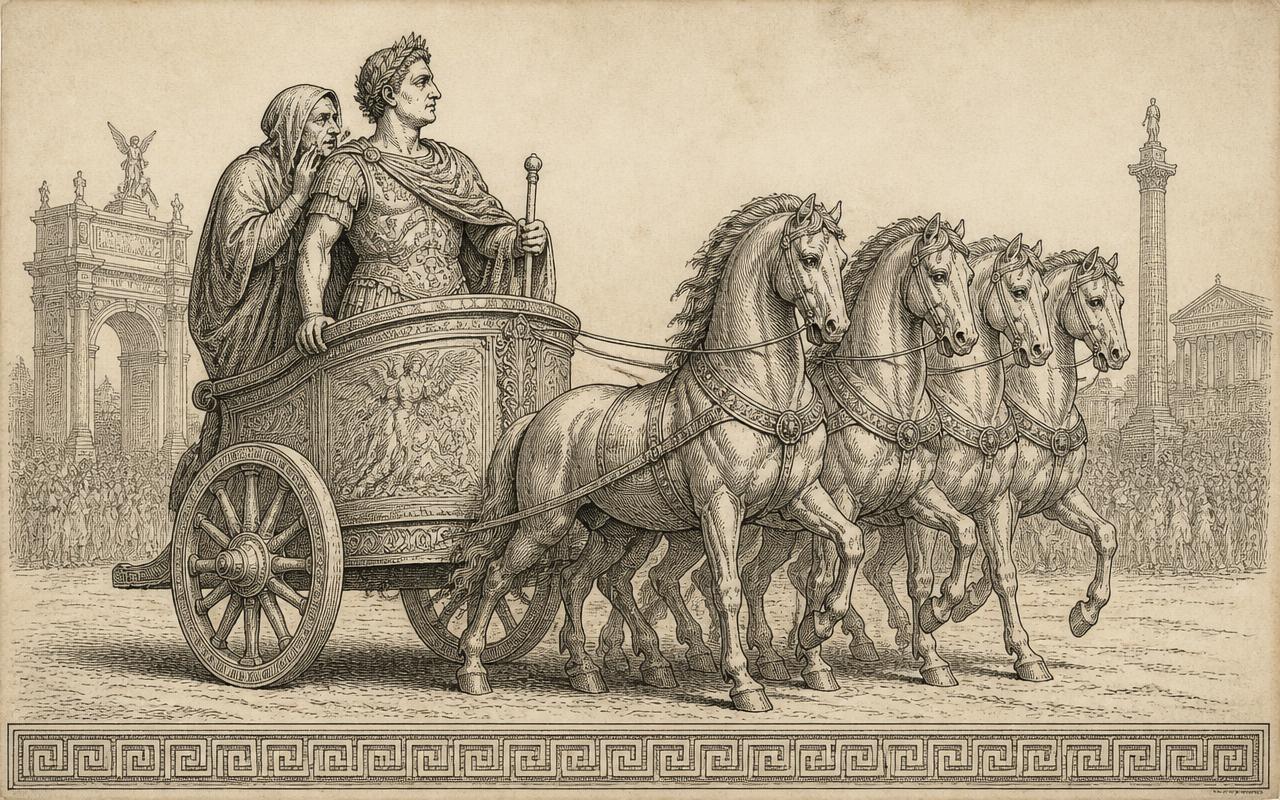
You have likely encountered this one. A victorious Roman commander rides through the city in a triumph — the formal parade granted for a major military victory. Behind him in the chariot stands a slave, holding the golden wreath above his head, and whispering memento mori into his ear so that the general does not mistake himself for a god.
It is a good story. It is also not quite what the sources say.
The account comes from Tertullian, a Christian writer in Carthage around AD 197, in his Apologeticus. What he reports the attendant saying is closer to: look behind you, remember you are a man. Not memento mori. The phrase itself does not appear in the passage, and Tertullian was writing more than two centuries after the triumphs he describes, with an argument to make about the vanity of pagan honours.
Whether some version of the ritual happened is plausible. Whether anyone said those two specific words in that specific chariot is not something the evidence supports.
This matters less as pedantry than as a signal. The idea has been useful enough, for long enough, that people have kept improving the story. That tells you something about the demand for it.
Where the practice actually comes from
The Stoics did not use the phrase much, but they built a discipline around the thing it points at.
Their term of art was praemeditatio malorum — the premeditation of evils. The exercise was to rehearse, deliberately and specifically, the losses you might suffer: your position, your health, the people you love, your own life. Not to wallow, but to remove the element of ambush.
Seneca wrote letters to a younger friend arguing that the problem is not that life is short but that we waste an enormous amount of it, and that a person who has prepared for loss is not destroyed by it. Epictetus, who had been a slave, told his students to remind themselves of the mortality of the people they love — including, bluntly, their own children — when kissing them goodnight. Modern readers find this passage cold. It is not cold. It is an instruction to notice what you have while you have it.
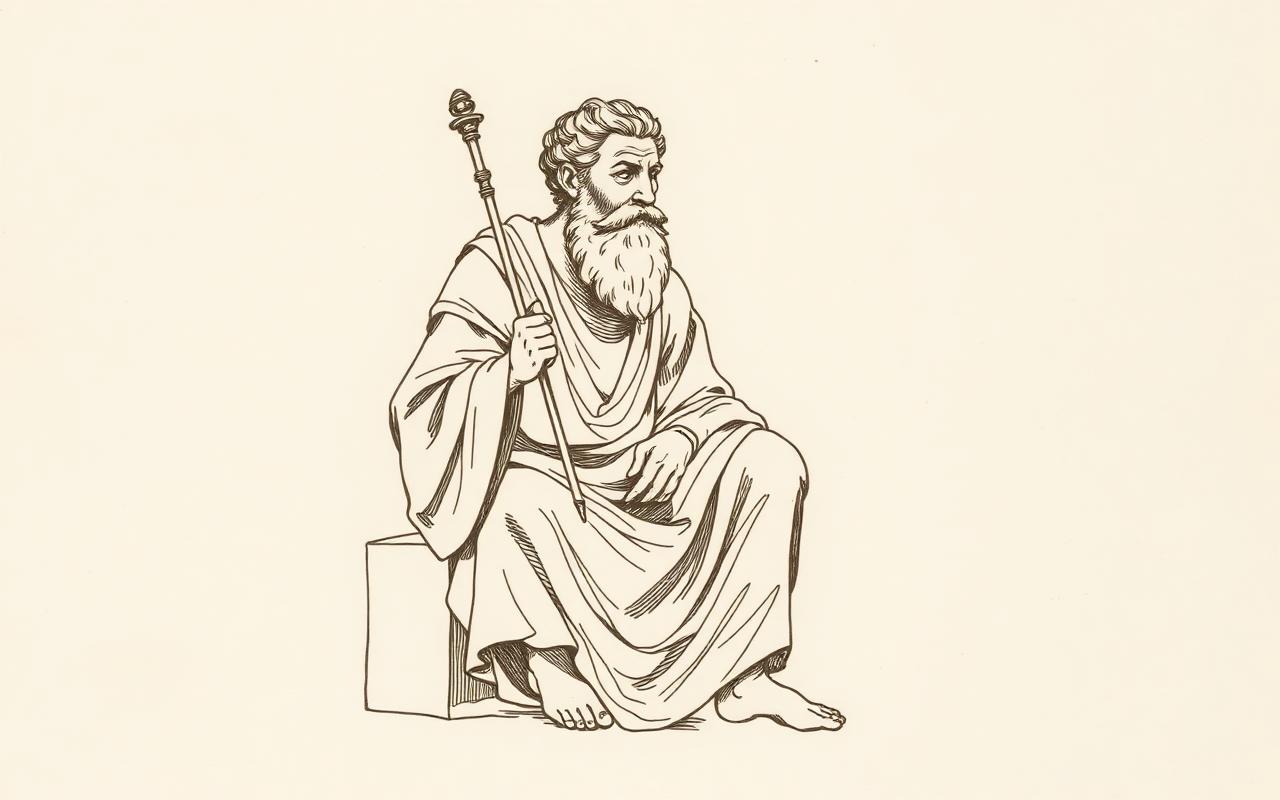
Marcus Aurelius, writing privately during military campaigns on the Danube, returns to the same point again and again: that you could leave life at any moment, and that this should govern how you act and what you say. His Meditations were notes to himself, never intended for publication, which is why they read less like philosophy and more like someone arguing with his own reluctance.
For a public-domain rendering, George Long's 1862 translation is the one to reach for. Most of the versions circulating on social media are modern translations still under copyright, often paraphrased further, and occasionally attached to sentences Marcus Aurelius never wrote.
Memento Mori
How many weeks have you already lived?
Enter your birthday and see your entire life represented on one page.
Show Me My Life →What happened to it afterwards
The idea did not stay Stoic.
Medieval and early modern Christianity absorbed it wholesale, with a different terminus. For the Stoic, remembering death was about living well now. For the Christian memento mori, it was about preparing for judgement later. The ars moriendi — the art of dying — was a genre of devotional manuals, the first appearing around 1415, instructing the reader on how to die properly.
Out of that came the vanitas paintings of the Dutch Golden Age: skulls, guttering candles, hourglasses, cut flowers already wilting, all arranged among the objects of a prosperous life. The visual vocabulary you now see on rings and posters was largely fixed in the seventeenth century by painters making a religious argument about the futility of wealth.
Which is a mild irony, given what the imagery is used to sell now.
What it is not
Three things it gets confused with, all of which it is the opposite of.
It is not morbidity. A preoccupation with death — the imagery, the darkness, the aesthetic — is a different thing entirely, and it tends to be static. The Stoic practice is instrumental. The point of the reminder is what you do in the twenty seconds after it.
It is not nihilism. The nihilist reading is that nothing matters because it all ends. The Stoic reading is the reverse: things matter more because they end, and the scarcity is precisely what confers the value. If your Sundays were unlimited, no individual Sunday would be worth anything.
It is not anxiety. Death anxiety is an intrusive, unwanted, often physical fear of dying. Memento mori is voluntary, scheduled, and brief. The clinical literature on death anxiety and the philosophical tradition of mortality reflection are describing different phenomena, and conflating them helps nobody. If you experience the first, the practice below is not a treatment for it, and a doctor is a more useful person to talk to than a Roman emperor.
The practice, specifically
Strip away the history and what is left is small.
Once a day, or once a week, you deliberately bring to mind that your time is finite and that today is one of a countable number. You hold it for perhaps thirty seconds. Then you ask one question: given that, is what I am about to do today the right thing to be doing.
That is the whole exercise. It is not long. It does not require silence, a cushion, or an app with a streak counter.
What it does require is a trigger. Left to itself, the thought does not recur — you have the realisation, it moves you for a day or two, and then it recedes exactly as every other realisation recedes. The Stoics solved this with journals, with rituals, and in Marcus Aurelius's case with the daily habit of writing to himself. The mechanism mattered as much as the idea.
Everything else — the ring, the skull on the desk, the print above the stairs — is an attempt at the same thing. Most of them fail for the same reason: an object you see every day becomes furniture within a fortnight.
If you want the tradition in more depth — the primary sources, the Stoic exercises in full, and the practical version you can actually run — I have put it in a short book. It is free, and it takes about ninety minutes to read.