Most people have never sat down and looked at their life on purpose. They have worried about it, which is a different activity and a considerably less useful one.
An audit is not worry. It is an inventory taken at a fixed time, against fixed questions, with a written output. Ninety minutes is enough. Less and you stay in the shallow answers; more and you start editing yourself for an audience that does not exist.
Here is the version I use.
Before you start
Block ninety minutes in one block. Not three thirty-minute sessions — the value is in the last twenty minutes, and you only get there by sitting through the boredom of the middle.
Paper, not a screen. Handwriting is slower than thinking, which is the point; it prevents you from producing the fluent, plausible answer you have given before. Your phone goes in another room.
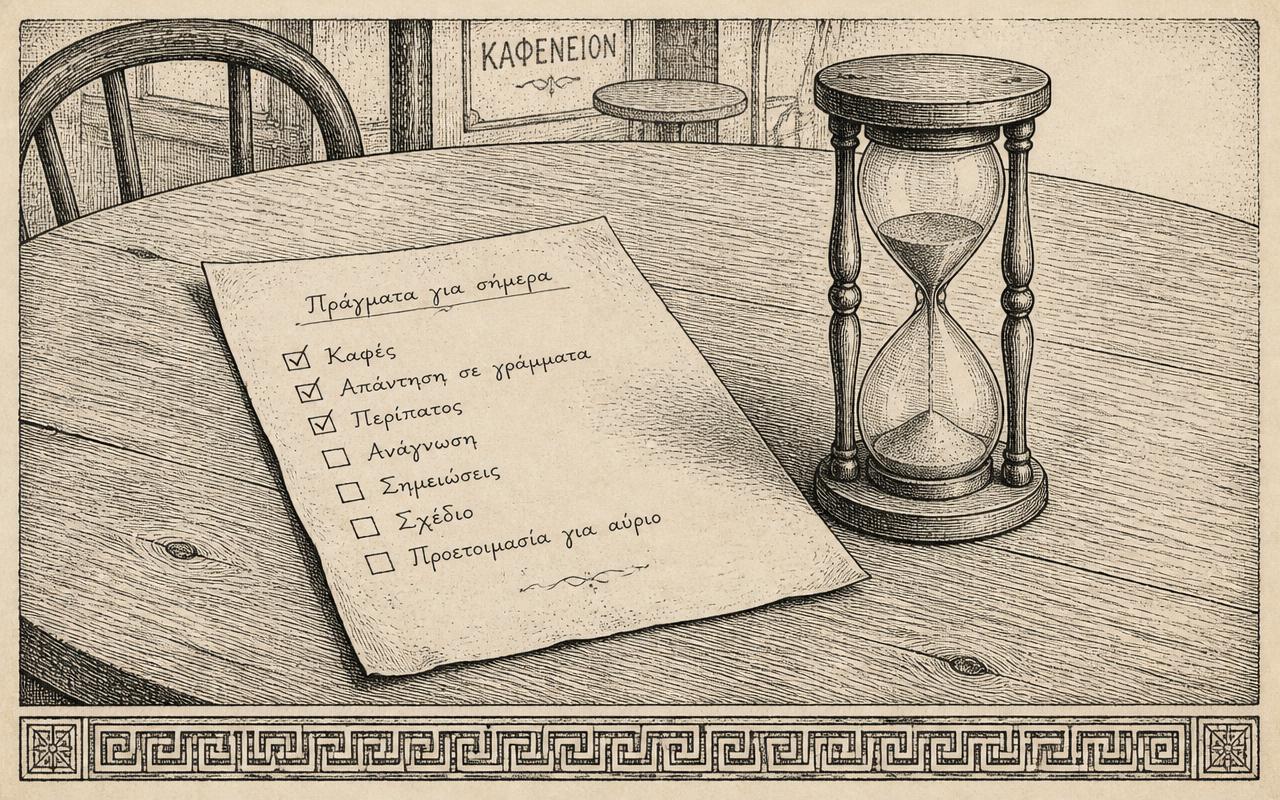
Do it somewhere that is not your home or your desk. A café, a library, a train. Familiar surroundings produce familiar answers.
One rule: nobody reads this. Not your partner, not later. The instant you write for a reader you start performing, and a performed audit is worthless.
The six questions
1. Where did the last year actually go?
Not where you meant it to go. Open your calendar and your bank statements — the two most honest documents you own — and go month by month.
Write down, for each month, the single thing that consumed the most of your attention. Not the most important thing. The thing that actually took the hours.
Most people find two or three months they cannot account for at all. That is data. Twelve unaccounted months is a year, and you have a countable number of those.
Worked example: a friend doing this found that seven of twelve months were dominated by a house renovation he had described, throughout, as "the thing I need to get out of the way so I can get on with it." Fourteen per cent of his remaining discretionary weeks, spent on a hallway.
Memento Mori
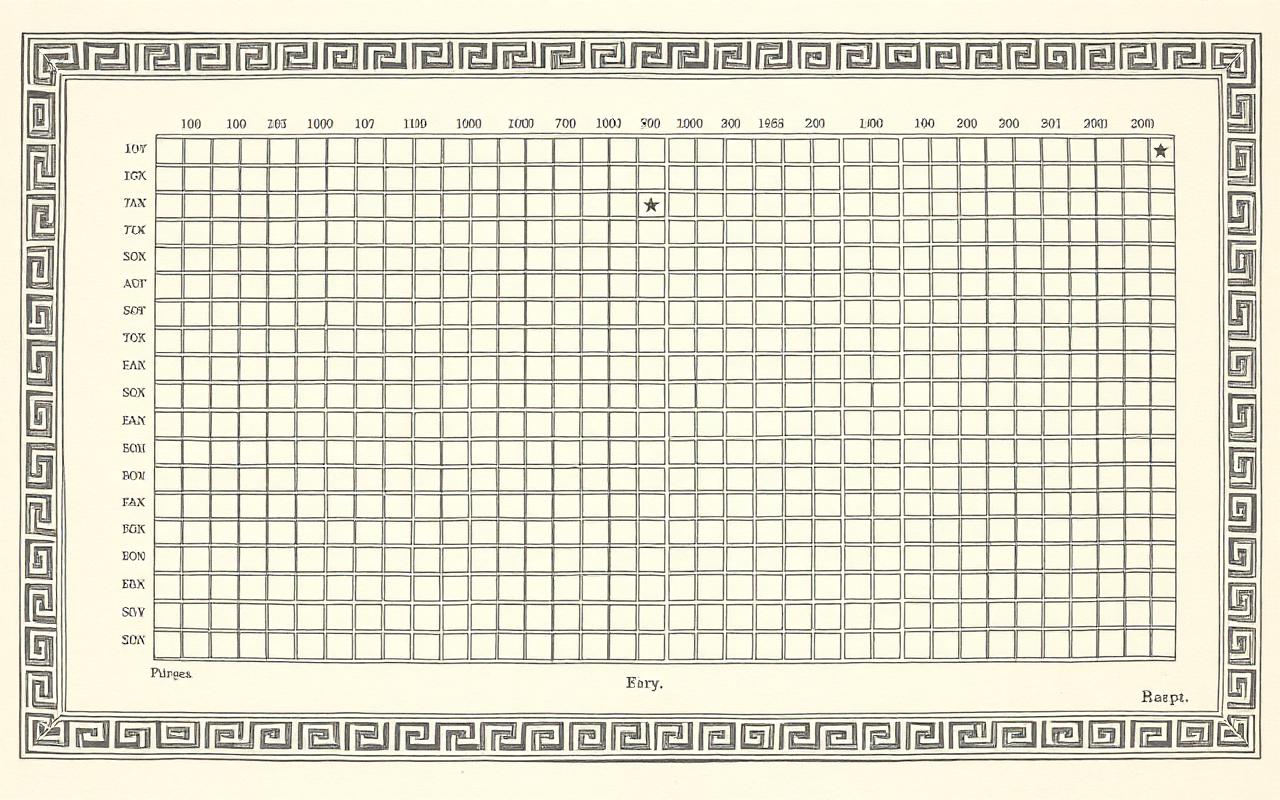
How many weeks have you already lived?
Enter your birthday and see your entire life represented on one page.
Show Me My Life →2. What are you waiting for permission to do?
Write the list without censoring it. Then, for each item, write who exactly you are waiting on.
Nearly always, the answer is nobody. The permission is imagined, and it is usually a proxy for a fear that would sound embarrassing written down — which is precisely why you should write it down.
4. Who gets your best hours, and who gets what's left?
Divide your waking day into your two or three sharpest hours and everything else. Then ask who receives each.
For most working people the sharp hours go to an employer and the remainder goes to the people they would say, without hesitation, matter most. It is not immoral. It is worth seeing clearly, once, in your own handwriting.
Then: how many of those remainder hours do you actually have left with each person? A parent you see four times a year, who is seventy, has perhaps forty-five visits left in the expected case. Not four hundred. Forty-five.
5. What are you doing purely to be seen doing it?
The job title, the postcode, the car, the marathon, the degree, the second home, the side project you talk about more than you work on.
Some things survive this question intact — you can want status honestly, and there is no shame in it. What you are looking for is the item you cannot justify to yourself once nobody is watching. There is usually one, and it is usually expensive in time.
6. If you had 800 weeks left, what changes on Monday?
Roughly the discretionary time remaining to someone in their mid-thirties — not total weeks, but awake, non-working, non-admin weeks.
Answer for Monday specifically. Not "I would be more present". What time do you get up, what do you not do, who do you call.
If nothing changes on Monday, one of two things is true: your life is already well-aimed, which happens and is worth knowing, or you have not believed the number yet.
What to do with the answers
Take one action from each of questions two, three and five, and put a date on it this week. Three actions, three dates. Not a plan — a plan is another way of deferring.
Then take the answer to question six and write it on a single line. That line is what you will need to be reminded of, because you will forget it. Everyone forgets it.
The part that determines whether this works
An audit produces clarity. Clarity has a half-life of about ten days.
I have watched people do this exercise, produce genuinely honest answers, feel the shift, and be entirely back to their previous shape inside a fortnight. Not because they were insincere. Because nothing in their ordinary week reintroduced the conclusion, and the ordinary week is very good at reasserting itself.
So the last step is not part of the audit. It is what happens after: deciding, now, how that single line from question six gets back in front of you when you are no longer in the mood for it. A weekly message on a Sunday morning. A daily one if you are at a decision point. Something you did not schedule that day and cannot anticipate.
Do the audit first. It takes ninety minutes and it is free, and even if you never do anything else you will know things about your own year that you did not know this morning.
The worksheet — six questions, printable, with the expectancy tables for question four — comes with the book. Both are free.