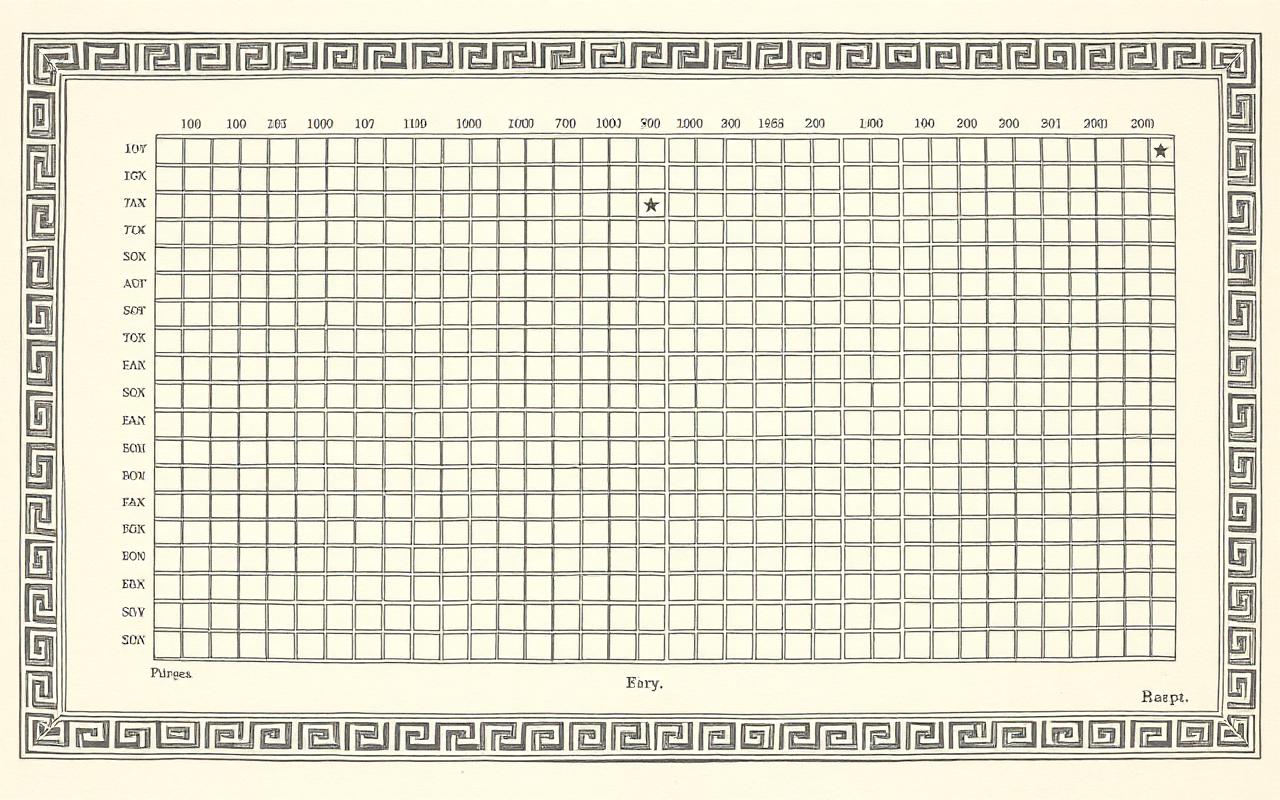
If you live to eighty, you get roughly 4,174 weeks. Round it down and call it four thousand.
That is the whole of it. Every Sunday you have ever had, every Sunday you will ever have, fits inside a number smaller than the population of a village. You could write them all out on a single sheet of A4 if the dots were small enough.
The figure comes from Oliver Burkeman, whose 2021 book Four Thousand Weeks took the arithmetic and made an argument out of it. But the sum itself belongs to nobody. Take your life expectancy in years, multiply by 52.18, and you have your own number. It takes four seconds and it is difficult to un-see.
The arithmetic, done properly
A year is not 52 weeks. It is 52.1775 weeks, which sounds like pedantry until you multiply it out and find it adds most of a year to a long life.
Life expectancy at birth in Sweden is about 81.5 years for men and 85 for women. In the United States it sits lower — roughly 75.8 for men and 81.1 for women. Take the Swedish male figure: 81.5 × 52.18 = 4,253 weeks.
There is a wrinkle worth knowing. Life expectancy at birth is not the number that applies to you if you are already thirty. It is an average that includes everyone who died in infancy, in accidents, at twenty-two. Having survived to thirty, your conditional life expectancy is higher — typically by two or three years. The actuaries call this survivorship. It means the honest version of your number is slightly more generous than the headline figure, and slightly less generous than you would like.
None of this precision matters much. Whether you have 4,100 weeks or 4,400, the shape of the problem is identical.
How many you have already spent
Multiply your age by 52.18.
Most people, reading their own line, feel a small drop. Not dread exactly — something closer to the sensation of checking a bank balance you had been avoiding.
The drop is informative. It tells you the number was doing work you did not know it was doing. You had a rough internal sense of how much life you had left, and it was wrong, and it was wrong in the same direction it is wrong for nearly everyone: you assumed more.
- At 25, you have spent 1,305 weeks. About 31 per cent.
- At 30, 1,565 weeks. Around 37 per cent.
- At 35, 1,826 weeks. Roughly 43 per cent.
- At 40, 2,087 weeks. Nearly half.
- At 50, 2,609 weeks. Comfortably past the midpoint.
Memento Mori
How many weeks have you already lived?
Enter your birthday and see your entire life represented on one page.
Show Me My Life →The weeks that are not really yours
Four thousand is the gross figure. The net one is smaller, and this is where it stops being an abstraction.
Sleep takes roughly a third. Eight hours a night across eighty years is about 1,390 weeks of the 4,174 — gone, non-negotiable, and mostly good for you.
Work takes another substantial slice. A forty-year career at forty hours a week, forty-six weeks a year, is 73,600 hours. Divide by the 168 hours in a week and you get 438 weeks of pure working time. Add commuting at an hour a day and you add another 50.
Then the admin of being alive: cooking, cleaning, queuing, filling in forms, sitting in waiting rooms. Time-use surveys across Europe and the US put household and personal maintenance at somewhere between two and three hours a day. Call it 900 weeks across a life.
What remains — genuinely discretionary, awake, yours — is somewhere between 1,200 and 1,500 weeks. At thirty, you are likely looking at eight or nine hundred of them left.
That is the number that should hold your attention. Not the four thousand. The eight hundred.
The part nobody tells you
Here is what happens next, and it happens to almost everyone.
You read the number. You feel the drop. You resolve to do something — call your father more, leave the job, book the thing you have been not-booking for two years. And within about eleven days, the resolve has gone. Not because you stopped believing the arithmetic. Because you stopped thinking about it.
This is not a character flaw. It is how attention works. A fact you learn once becomes background almost immediately; the brain is efficient about demoting anything that does not change. The same mechanism that lets you stop noticing the hum of a fridge lets you stop noticing that you are mortal.
Which is why the poster on the wall does not work. Why the ring on your finger stops registering by the second week. Why the person who reads a book about death on a flight to Málaga is, by the Wednesday after, behaving exactly as they did before.
The information was never the missing piece. Almost everyone already knows they are going to die. The missing piece is a mechanism that reintroduces the fact on a schedule, in a form you cannot pre-empt, at a moment you did not choose.
What to do with the number
Two things, in order.
First, look at it properly. Not as a sum in your head but laid out — every week of your life as a single mark, the spent ones filled in, the remaining ones empty. The visual does something the arithmetic does not. A number can be argued with. A grid where a third of the dots are already black cannot.
Second, decide how it gets back to you. Weekly is enough for most people. Daily is better if you are at a decision point — a job you are unsure about, a relationship you are avoiding a conversation in, a project you keep deferring to a version of yourself who has more time.
The Stoics did the second part by habit and temperament, without help. Marcus Aurelius wrote his reminders to himself at the end of long days on campaign, which is a form of scheduling. Most of us are not going to keep that up unprompted, and there is no particular virtue in pretending otherwise.
Start with the first part. See your own grid, with your own dates, and see how much of it is already filled.